
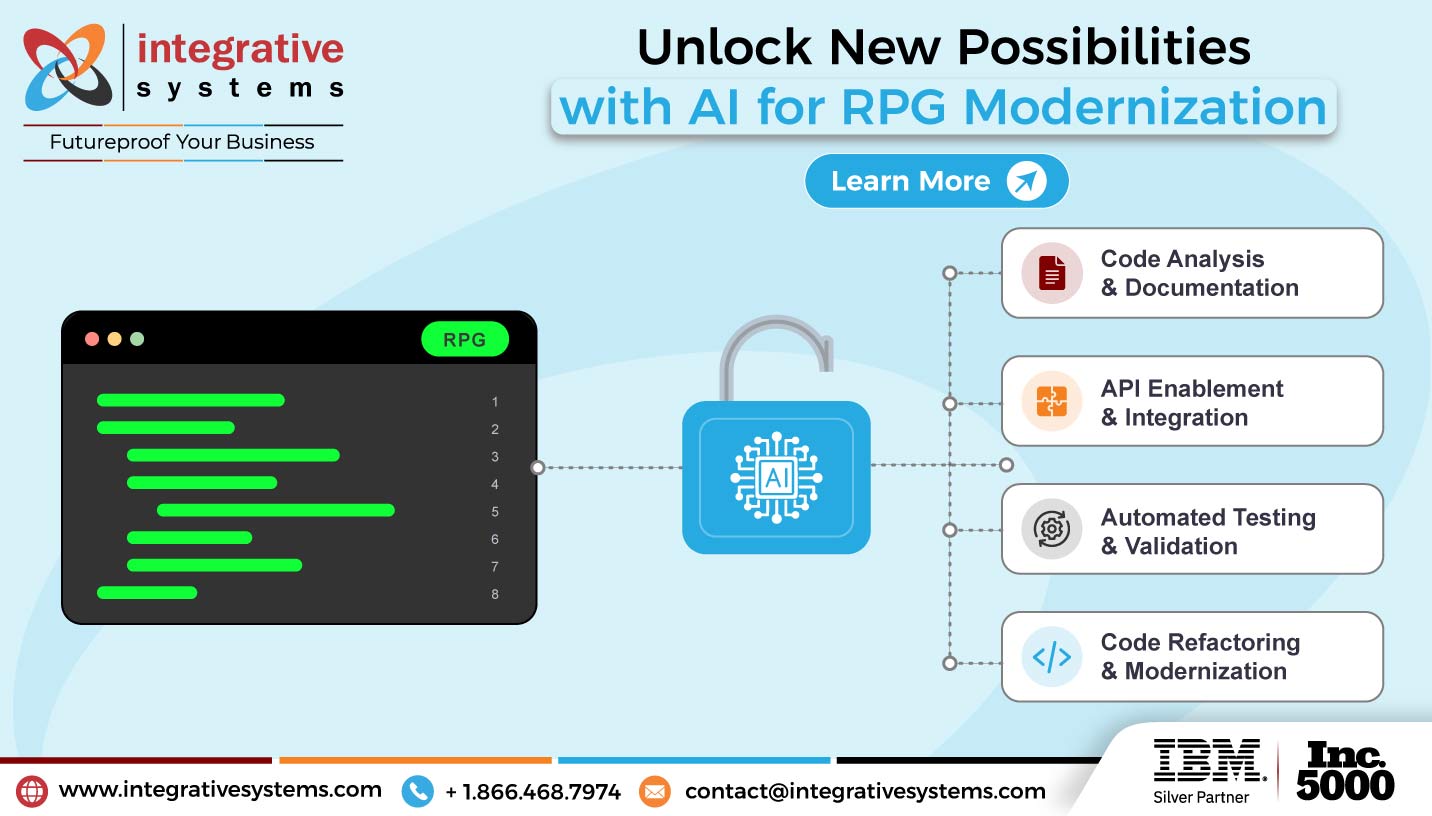
A successful IBM i modernization strategy can include database modernization, RPG code modernization, green screen modernization, infrastructure modernization, and hardware modernization – all while keeping your existing business logic intact.
When it comes to IBM i RPG code modernization, it doesn’t require a big-bang approach. You can start by converting fixed-format RPG into free-format RPG and gradually build from there.
AI can help your businesses by analyzing, converting, and refactoring legacy business applications using coding agents and LLMs.
Much of this RPG code has been running your mission-critical operations for twenty to thirty years. Understanding, documenting, and maintaining this code has become exceptionally important, as original RPG developers are retiring. That’s where AI helps to speed up the process and boost efficiency.
Fortra’s 2026 IBM i Marketplace Survey says, “IBM i skills have become the top concern for IBM i shops, reinforcing the need to understand applications, business logic, and data before introducing AI.”
Want to know more? Let’s first start with AI for RPG modernization.
What is AI-assisted RPG Modernization?
Your IBM i team can bridge the knowledge gap and transform legacy code without breaking hidden business logic by using AI coding agents and LLMs.
Speedier Code Understanding & Documentation – Your team can use AI agents like Bob to reverse-engineer decades-old green-screen RPG, COBOL, and DDS codebases in minutes, helping you create architecture flowcharts, overviews, and comprehensive business rule reports.
Fixed-to-Free Format Conversion – Using AI tools, you can automate the translation of legacy fixed-format OPM/ILE RPG into modern, free-format RPG.
IDE Integration – By leveraging extensions like Code for IBM i inside Visual Studio Code, your developers can prompt AI assistants directly inside active workflows.
To gain the endless benefits from AI, you first need to understand why your business needs AI for modernizing RPG in 2026.
Why AI for RPG Modernization is Needed?
AI is needed for RPG (Report Program Generator) modernization – the process of updating legacy IBM i / AS400 business applications – because legacy code is massive, complex, and losing its human caretakers.
Key Reasons AI is Needed –
- RPG systems helped you run business-critical operations related to hospitals, banks, and factories, where business rules live inside green-screen code undocumented. In such a scenario, AI helps in analyzing this code and mapping out complex program dependencies.
- As RPG developers are retiring, AI coding assistants like IBM watsonx Code Assistant help developers to interpret and convert legacy code faster, by managing skill gaps.
- AI automates mechanical tasks like boilerplate generation, code translation, and test scenario creation.
- AI accelerates refactoring, ensuring core systems can manage higher workloads without a risky teardown.
- AI-analyzed code minimizes long-term technical debt and makes the system easier to maintain and safer.
When you combine AI with human expertise, you actually start to future-proof your legendary IBM i system. See how our approach differs.
How We Approach AI for RPG Modernization
AI is reshaping the way your IBM i team is working.
To automate discovery, documentation, code refactoring, and API integration, AI tools help modernize RPG applications.
Our expert, Stephanie Rabbani, senior IBM i engagement manager, has divided the process into five parts.
Code Discovery and Architecture Mapping
We use specialized AI coding assistant IBM Bob to scan legacy RPG III or OPM fixed-format codebases to analyze complex dependencies, database flows, and high-level architecture in minutes.
Business Rules Extraction
AI is becoming increasingly effective at reading code and documenting it. We create AI instructions specifying the information needed, and AI organizes and documents that information.
We store the documentation in Markdown, Wikipedia, or other formats. This helps us build a knowledge base of code, making it easier to understand hidden business logic, calculation rules, validation routines, and decision trees.
Example – If you have System/36 code written in RPG II, using fixed format throughout. It is hard to read and difficult to work with. Having proper documentation can make this code much easier to understand.
Refactor Fixed-Format to Free-Format RPG
Using AI tools, we start incrementally updating the fixed-format code into free format ILE (Integrated Language Environment) RPG, making it easier to read and maintain.
We can also refactor large monolithic applications into smaller, more modular components using modules and service programs.
This makes it easier to expose existing business logic through APIs and other interfaces, allowing modern languages and applications to access and use the information and functionality already available in your IBM i environment.
Generating APIs and Natural Language Integration
Our IBM i experts use natural language prompts to generate REST APIs, connect IBM i databases to external web services, or process natural language commands.
Impact Analysis and Testing
Our experts use AI tools to run impact analyses to trace how a modified or newly added field (such as a tracking metric or date) ripples through multi-layered programs before altering core data structures. We also auto-generate unit tests and validation plans.
Other than this, AI assistants also helps in converting the old RPG code entirely into languages like Java, Python, or C#.
But converting record-level access to SQL is not a one-to-one process. It’s a pretty complicated one and needs consideration of current business logic.
The day that you write everything else in Java, three days later, that code becomes legacy because there’s always going to be new versions of any language, any piece of code, new development, new developers.
So, do we need to go off RPG? Not necessarily.
We’ve got various tools and lots of opportunities to modernize legacy RPG code without rewriting.


