
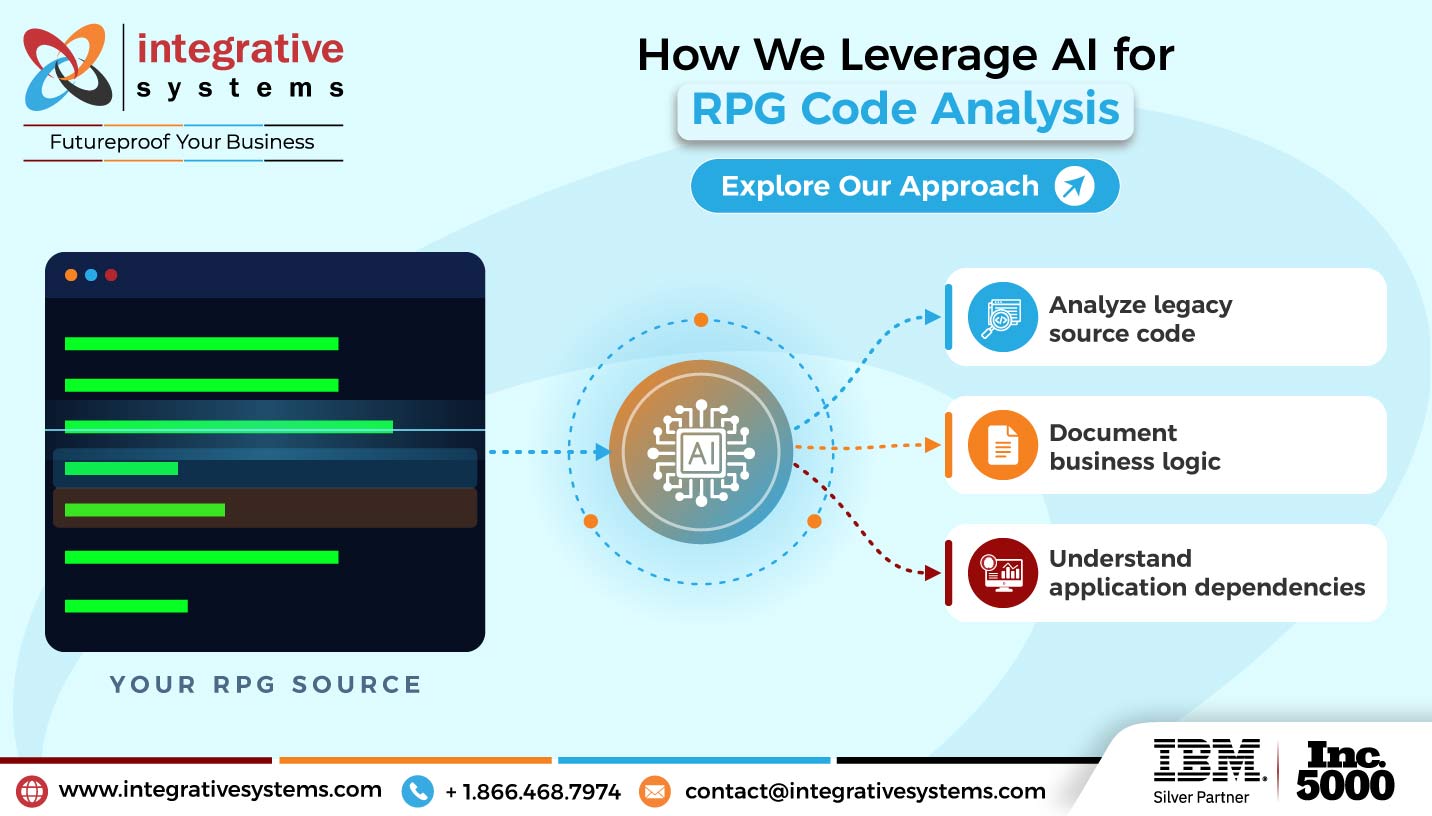
“How do you use AI for RPG code analysis?” – a recurring question our team heard at the COMMON NAViGATE 2026.
AI is magnetic; it’s contagious! We were overwhelmed to see the curiosity. To answer that question and make our approach to AI a little more public, here we are.
91% of IBM i organizations use RPG for development. With so many business applications relying on the language, understanding existing RPG code remains important as organizations plan application improvements and modernization.
~ According to Fortra’s 2025 IBM i Marketplace Survey.
Over decades of development, RPG applications have accumulated business rules, processing logic, data interactions, and dependencies that are not always documented.
AI for RPG code analysis can help developers examine this existing code, explain program behavior, identify potential dependencies, and prepare technical documentation.
At Integrative Systems, we pair AI-assisted capabilities with experienced IBM i development expertise to help you understand your RPG applications and make well- informed modernization decisions.
Why is Understanding Legacy RPG Code Challenging?
Understanding legacy RPG code is challenging because application functionalities grow and evolve with changing business needs. Business rules, processing logic, and program dependencies grow, but documentation may not have all the records.
RPG developers keep on adding features and modifying programs. With limited scope for documentation, the application knowledge stays with individual team members. This leads to scattered source code and technical documentation.
This makes application maintenance cumbersome, particularly when teams have to –
- Understand program functionality in the absence of reliable documentation
- Trace business rules embedded in complex processing logic
- Verify relationships between programs, files, and data
- Maintain applications when experienced developers are no longer available
Before changing an application, teams need a reliable understanding of how it works. AI-assisted RPG code analysis can give developers a useful starting point for that investigation.

How can AI Analyze Legacy RPG Code?
RPG developers can use AI-assisted analysis to evaluate RPG source code to spot areas that need prompt attention. It helps save time & effort for manually tracing every instruction.
| Analysis Area | What Developers can Investigate |
| Program structure | Procedures, sections, and processing flow |
| Conditional logic | Conditions that influence program execution |
| Data handling | File references, record operations, and data updates |
| Program interactions | Calls and references to other application components |
“AI helps developers examine RPG code faster. But understanding how that code supports business operations requires IBM i expertise.”
~ Stephanie Rabbani | Sr. Engagement Manager – IBM i, Integrative Systems.
These findings help developers understand what is present in the source code.
They do not automatically establish how the wider application behaves. That requires further investigation and technical validation.
Can AI Explain What an Existing RPG Program Does?
AI interprets RPG source code and generates explanations of program functionalities, workflow steps, dependencies, and calculations. It helps RPG developers understand how individual programs work, without digging into manual code reviews.
For an instance, imagine an RPG program responsible for processing customer orders.
It may validate order details, calculate transaction values, check inventory, and update records.
AI-assisted analysis helps RPG developers evaluate these operations and put together an initial explanation of the program.
| What the Developer Investigates | What the Analysis can Help Explain |
| Order validation | Conditions that determine whether an order proceeds |
| Pricing calculations | Logic used to calculate transaction values |
| Inventory checks | Data references and conditions affecting stock processing |
| Program calls | Other programs involved in the processing sequence |
| Record updates | Files and data operations performed by the program |
At Integrative Systems, our IBM i developers bring application context into this review. They examine the source code and available technical documentation to determine whether an explanation accurately represents the program’s behavior.
How can Developers Document IBM i Applications Using AI?
Developers can use AI to generate initial documentation from RPG source code. It may include explanations of program functionality, processing logic, data interactions, and potential dependencies. Further, IBM i experts must validate the documentation and findings.
This helps translate initial code analysis findings into a validated technical reference that the development team can trust.
Depending on the scope of analysis, documentation may include –
- Program Functionality – What a program is responsible for and which operations it performs.
- Processing Logic – Conditions, calculations, and key processing steps.
- Data Interactions – Files and records referenced or updated by the program.
- Program References – Calls and relationships that require further investigation.
- Business Rules – Operational decisions reflected in the source code.
The goal is to make application knowledge easier to access, review, and maintain as development responsibilities change.
How can AI Identify Hidden Business Rules and Program Dependencies?
AI-assisted RPG analysis can help identify business rules embedded in RPG source code and call out possible program calls, file references, and data interactions.
Further, RPG developers can investigate to understand application dependencies.
Business rules aren’t always documented separately. They may be present in the conditions, calculations, validations, and data-processing instructions across multiple RPG programs.
Equivalently, identifying a program call doesn’t justify dependency.
RPG developers need to dig deeper to investigate what data is being passed, what the called program does, and how the output adds up to the complete application workflow.
For example, imagine a program may call another routine to calculate a transaction value.
Understanding the dependency requires examining the information passed to that routine, the calculation it performs, and how the result is used by the calling program.
AI-assisted analysis can help identify these relationships for investigation. IBM i developers then evaluate their significance in the context of the application and its business processes.
How can AI-Assisted Code Analysis Support IBM i Modernization?
AI-assisted code analysis supports IBM i modernization by helping developers understand existing application logic, document functionality, investigate dependencies, and identify areas that require further assessment before changes are planned.
Modernization decisions depend on understanding the applications you’re already operating on. An RPG program that appears difficult to maintain may contain business logic that your business still relies on.
Changing or replacing it without understanding those requirements can introduce unnecessary complexity and risk.
Analysis findings help our development teams –
- Assess Existing Applications – Understand program functionality and processing logic before proposing changes.
- Investigate Dependencies – Identify relationships that may be affected by application improvements.
- Support Knowledge Transfer – Make technical information more accessible to development teams.
- Prioritize Modernization – Establish which areas require further investigation and evaluation.
The goal is to understand the existing environment before recommending an appropriate modernization approach.
How do IBM i Experts Validate AI-Generated Documentation?
To validate AI-generated documentation, IBM i experts must review the original source code, cross-check processing logic, seek application dependencies, and compare the explanation with available business & technical context.
AI-generated explanations are used as a starting point. They aren’t used as a complete source of truth unless validated otherwise by IBM i experts.
An AI-generated explanation may mark a section of RPG code as correct while tossing up application-specific condition, or dependency. To nullify those risks, an expert judgement by IBM i professionals is quintessential.
| AI-Assisted Analysis | IBM i Expert Review |
| Examines source-code structures | Interprets application-specific context |
| Generates explanations of program logic | Checks explanations against the original code |
| Highlights potential program references | Investigates relationships between components |
| Prepares initial documentation | Reviews and corrects technical explanations |
| Identifies areas for further investigation | Assesses business impact and modernization relevance |
“Code documentation is only valuable when it reflects how the application actually works. That’s where expert validation makes the difference.”
~ Stephanie Rabbani | Sr. Engagement Manager – IBM i, Integrative Systems.
AI surely helps accelerate code investigation and documentation. But, experienced IBM i developers must validate if the findings accurately represent the application and provide a sound basis for further decisions.
Decode Your RPG Applications with Integrative Systems
Understanding existing RPG applications is an important step toward maintaining and modernizing them.
We combine AI-assisted code analysis with experienced IBM i development expertise to examine RPG programs, understand application logic, document existing functionality, and investigate dependencies.
Our focus is on the applications and business processes that you already rely on.
By bringing AI-assisted analysis and IBM i expertise together, we help build a clearer understanding of the existing environment and evaluate the next steps.
Looking to understand your RPG applications before making modernization decisions?
Talk to our IBM i experts to explore how AI-assisted RPG code analysis can support your application assessment and modernization plans. Drop us a line at contact@integrativesystems.com , and we’ll take it from there.
Frequently Asked Questions about AI for RPG Code Analysis
1. What Details are Required to Begin AI-Assisted RPG Code Analysis?
To start with AI-assisted RPG code analysis, you primarily need access to the relevant RPG codebase and available application documentation. RPG code analysis precision differs based on programs assessed, scope of analysis, and access permissions.
2. Can AI Analyze RPG Programs Written in Older RPG Versions?
AI can analyze RPG programs written in older RPG versions. The analysis may vary based on code format, context, and tooling capabilities. Most importantly, a technical review by an experienced IBM i professional is mandatory for older applications.
3. What’s the Difference Between RPG Code Analysis and RPG Code Modernization?
RPG code analysis involves code investigation to understand dependencies and business logic without making any changes to the code. Whereas RPG code modernization involves code rewriting, refactoring, and conversion to bring the code closer to modern and maintainable structures.
4. How can RPG Code Analysis Support Knowledge Transfer?
It can help create structured explanations of program functionality, processing logic, and data interactions. These references can help development teams share application knowledge and support ongoing maintenance.
5. Can AI-assisted RPG Code Analysis Replace RPG Developers?
AI can certainly assist with code analysis and documentation, but experienced RPG developers are needed to validate findings, interpret business context, and assess application changes.
6. Can AI-Assisted RPG Code Analysis Help Plan Application Modernization?
AI-assisted RPG code analysis can offer insights into existing functionality, business rules, and potential dependencies. But the development teams must validate these findings in practice when evaluating modernization priorities and approaches.


