

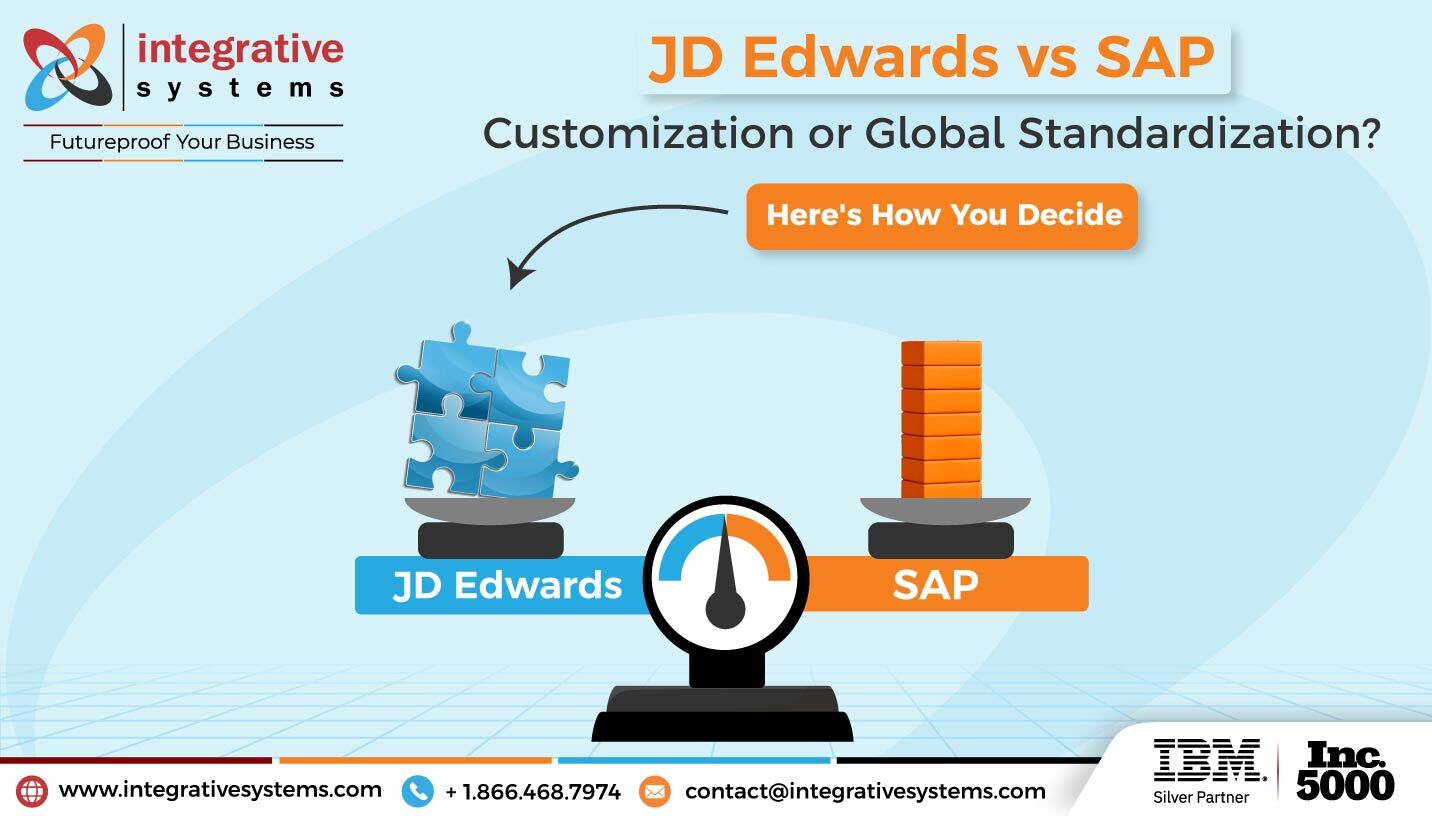
Your choice among JD Edwards vs SAP varies based on your company size, workflow complexity, and long-term business objectives.
JD Edwards EnterpriseOne is best suited for asset-intensive industries. Especially industries that demand prudent features to support manufacturing ops, lower implementation complexity, and deployment flexibility.
SAP ERP is best suited for large-scale enterprises that need structured business processes and comprehensive support for the enterprise ecosystem.
Today, we are going to discuss JD Edwards vs SAP ERP across parameters, including deployment, implementation, customization, long-term value, and total cost of ownership.
This read will help you arrive at a decision for the best ERP that fits your current and future business needs.
Let’s get started!
What Is JD Edwards?
JD Edwards E1 is an ERP platform developed by Oracle. It’s best suited for companies that appreciate deployment flexibility and industry-specific system functionalities.
JD Edwards is popularly used by organizations that are resource-intensive. The list includes, but is not limited to –
- Manufacturing
- Construction
- Engineering
- Distribution
- Real Estate
JD Edwards supports on-premises, cloud, and hybrid deployments. It offers a modular architecture allowing companies to begin with the capabilities that they need. These capabilities can be scaled as per changing business needs.
CONTACT US NOW
What is SAP ERP?
SAP is an enterprise ERP solution. It is built for large-scale companies to support global operations. SAP unifies core business functions, including supply chain, procurement, manufacturing, finance, and others, into a connected business ecosystem.
SAP ERP is well known for its comprehensive enterprise-wide standardization support across business units and geographies.
Perhaps, due to its complex functionality set, it requires longer implementation timelines, involves customization complexity, and higher investment.
JD Edwards vs SAP Comparison at a Glance
| Comparison Area | JD Edwards EnterpriseOne | SAP ERP |
| Best suited for | Mid-sized to large enterprises | Large global enterprises |
| Deployment | On-premises, cloud, hybrid | Primarily cloud with on-premises options |
| Implementation | Faster and more flexible | Longer and more complex |
| Customization | High | Moderate to High |
| Manufacturing | Strong industry-specific capabilities | Extensive global manufacturing support |
| Asset Management | Excellent | Strong |
| Integration | Oracle ecosystem and third-party applications | Extensive SAP ecosystem |
| Total Cost of Ownership | Generally lower | Generally higher |
| Ideal Choice | Flexibility and operational efficiency | Global process standardization |
Both ERP platforms deliver enterprise-grade capabilities. The right choice depends on your industry, operational complexity, deployment strategy, and long-term business goals.

JD Edwards vs SAP – Key Differences
JD Edwards and SAP are both compatible with enterprise operations. The key parameters they differ on are implementation complexity, operational compatibility, and long-term ROI.
Deployment and Flexibility
JD Edwards provides on-premises, cloud, and hybrid deployment support. It makes the best fit for companies that have already invested in infrastructure or have industry-wise compliance needs.
SAP has moved to a cloud-first approach. This proves advantageous for companies seeking enterprise-wide standard implementation. Perhaps, this involves adept migration planning.
Implementation
JD Edwards supports modular implementation. This lets companies deploy modules in a phased manner. Later, as business requirements grow, implementation can be scaled up with low-to-no operational disruption.
SAP ERP implementations often call for larger business transformation initiatives. It requires longer implementation timelines and steeper change management.
Customization
JD Edwards adapts to existing business processes and ecosystem. It also supports future upgrades with low-to-no operational disruptions.
SAP ERP is focused on predefined standard processes. Companies picking SAP must align their existing business processes and operations with the solution.
Industry Fit
JD Edwards is popular among manufacturing, construction, engineering, distribution, and other resource-intensive sectors.
Whereas SAP holds a strong presence among multi-national enterprises across manufacturing, retail, healthcare, financial services, and utilities.
Total Cost of Ownership
ERP investment goes past licensing costs. It involves costs for implementation, infrastructure, customization, user training, support, and upgrades.
In a neck-to-neck comparison of JD Edwards vs SAP, the former offers lower total cost of ownership than the latter. Though SAP demands a high up-front investment, it delivers diligently for companies operating on a global scale.
Upgrades and Maintenance
JD Edwards supports easy, modular upgrades. This allows companies to adopt new functionality sets without undergoing rigorous customization or operational overhaul.
SAP ERP also offers regular upgrades. Perhaps, SAP upgrades are complex to execute given database dependencies, code adaptability issues, and the risk of operational disruption.
“When organizations compare JD Edwards and SAP, the decision shouldn’t be driven by feature count alone. The ERP that delivers the greatest long-term value is the one that aligns with your operational model, implementation capacity, and future growth strategy.”
~ Colin Galdo | JD Edwards E1 Engagement Manager, Integrative Systems.
Key Takeaway
JD Edwards E1 makes a great fit if your priorities are –
- Low implementation complexity
- Industry-specific system functionalities
SAP ERP makes a great fit if your priorities are –
- Better long-term fit
- Enterprise-grade standardization across global ops
JD Edwards vs SAP, Which ERP is Right for Your Business?
Your choice for an ideal ERP solution depends less on the ERP features and more on the way your business operations run and your future growth plans.
You may Choose JD Edwards If…
JD Edwards EnterpriseOne makes the best fit if you’re looking for flexibility, industry-specific functionality, and lower implementation complexity.
JD Edwards E1 offers the best compatibility if you operate in –
- Manufacturing
- Construction
- Engineering
- Distribution
Or, any of the resource-intensive industries.
JD Edwards EnterpriseOne can be counted on, if you’re seeking –
- On-premises, on cloud, or hybrid deployment
- Lower total cost of ownership and implementation
- Choice to adopt feature set via incremental upgrades
- Retention of core business processes & modernization of existing ERP
If you’re already running on JD Edwards, considering options for ERP migration could be the last thing you may think of.
Before the big step, you can consider investing in JD Edwards consulting services or JD Edwards support services. Through this association, JD Edwards consultants help you assess your JDE environments and identify opportunities for optimization and alignment.
You may Choose SAP If…
SAP makes the best fit if your operations are spread across countries or business units and you need a standardized process with centralized governance.
SAP ERP can be considered if you –
- Want standardized enterprise processes across units
- Wish to utilize SAP’s comprehensive enterprise ecosystem
- Operate at a global level, governed by strict regulatory requirements
- Can support longer implementation timelines and larger transformation programs
JD Edwards vs SAP – Checklist to Arrive at a Decision
Before you arrive at a decision between JD Edwards vs SAP, answer –
- Do I need flexibility or a globally standardized ERP?
- Should I upgrade my current ERP or replace it?
- Can I support the implementation timeline and budget?
- How much customization will I need in the future?
- Do I have the right expertise to manage upgrades and integrations?
Your answers will help you decide between JD Edwards and SAP.
According to Oracle, JD Edwards EnterpriseOne continues to receive continuous innovation updates, enabling organizations to adopt new capabilities without disruptive full-scale upgrades. For many businesses, optimizing an existing JD Edwards environment delivers greater long-term value than replacing it with a new ERP platform.
How Expert JD Edwards Services Maximize ERP Value?
Selecting the right ERP for your business is just the first step. Long-term success is determined based on how effectively JD Edwards is implemented, maintained, integrated, and undergoes regular upgrades as your business needs evolve.
Experienced JD Edwards consultants help you optimize ERP performance through –
- JD Edwards managed services for proactive monitoring and performance optimization
- JD Edwards upgrade services to adopt new capabilities with minimal disruption
- JD Edwards integration with CRM, reporting, warehouse, and third-party applications
- Support from JD Edwards developers for customization and workflow automation
- JD Edwards CNC consultants’ expertise to manage infrastructure, security, and environments
Companies are also considering JD Edwards automation to streamline redundant workflows and reduce administrative effort.
Pro Tip –
Before deciding to rip and replace your ERP, assess whether structured upgrades, performance optimization, or workflow automation can help achieve your business goals at lower cost and with less disruption.
~ Colin Galdo | JD Edwards E1 Engagement Manager, Integrative Systems.
If you’re planning to futureproof your JD Edwards environment, a readiness assessment would be the best place to start. It helps identify optimization opportunities right before you begin with a transformation initiative.
Schedule Your Complementary JD Edwards Assessment
Frequently Asked Questions
1. Which is better, JD Edwards or SAP?
Between JD Edwards vs SAP, the best choice solely depends on your business needs. JD Edwards EnterpriseOne is best suited if you value modular architecture, flexibility, industry-specific function sets, and low implementation complexity. SAP ERP is the best choice if you value standardized processes that can be scaled at a global level.
2. What is the Difference between JD Edwards vs SAP ERP?
The difference lies mainly in the way they are implemented. JD Edwards provides deployment flexibility and customization, whereas SAP focuses on standardized enterprise processes and a broader application ecosystem.
3. Is JD Edwards more Cost-Effective Compared to SAP?
JD Edwards offers a lower total cost of ownership due to its modular implementation, flexible deployment options, and simpler upgrade model. Perhaps, actual costs depend on licensing, customization, and ongoing support required.
4. Should I Upgrade JD Edwards or Migrate to SAP?
Approaching a JD Edwards upgrade or migrating to any other ERP are advanced solution and needs an evaluation before you begin. Most companies have attained higher ROI by investing in JD Edwards consulting services. Seasoned JDE consultants conduct an assessment of your JDE environment and help find the right direction based on your business objectives and future growth plans.
5. Which Industries Use JD Edwards?
JD Edwards is used by manufacturing, construction, engineering, distribution, real estate, and other resource-intensive industries. For industries that reward operational and supply chain management capabilities, JD Edwards makes a great fit.
6. How JDEdwards Consultants Help Businesses?
JD Edwards consultants provide support for implementation, upgrades, integrations, automation, and ongoing optimization. They help companies optimize ERP performance while reducing operational risk.

