Through JDE support services, JDE experts help manufacturing companies optimize JD Edwards EnterpriseOne through proactive system management, application support, CNC administration, custom development, and continuous process optimization.
They improve production planning, inventory accuracy, operational efficiency, and long-term ERP performance while reducing business disruption.
By 2027, more than 70% of recently implemented ERP initiatives will fail to fully achieve their original business case goals. For manufacturers, ERP value isn’t determined at go-live but by how well it evolves with changing operations.
~ As per Gartner.
Key Takeaways
- What JDE support services include
- Manufacturing challenges they solve
- Why traditional ERP support falls short
- How proactive support improves operational efficiency
- How to choose the right support partner
Still thinking if you should invest in JD Edwards services?
Math is quite simple.If you’re running your JDE EnterpriseOne on a pre-9.2 version, through JDE upgrade services you can upgrade to the latest version.
If you’re keen on reducing manual intervention and improving data accuracy, through JDE automation & integration services you can attain it.
And, if you wish to futureproof your JDE EnterpriseOne environment to keep it thriving for long, you can resort to JDE consulting services.
Your JD Edwards E1 is a well-oiled machine, and it has been a backbone of your manufacturing operations.
7/10 JDE-led manufacturers we speak to confirm that their EnterpriseOne ERP runs just fine.
Production orders are being created. Financials are getting reported. MRP runs are scheduled. Inventory is moving.
From a system standpoint, everything is functioning.
But when we spend time with their operation’s team, a whole different picture emerges.
Planners are re-checking the MRP outputs. Production supervisors are revising production plans for routine operations. Finance teams are explaining variances after submitting financial reports. Inventory teams are re-verifying stocks physically before committing orders.
The system is working. But the business is compensating.
This gap doesn’t come from system failure. It comes from operational drift.
JDEdwards continues to execute based on how it was configured, often years ago. Meanwhile, your manufacturing environment evolves.
Product mixes change. Demand patterns shift. Supply chains become more volatile. And the operational constraints move.
Over time, your system and business stop reflecting each other.
Not dramatically. Not all at once.
But enough to make everyday decisions harder than they should be.
Let’s understand what JDE challenges make manufacturers seek JDE support.
What Manufacturing Challenges JD Edwards Support Services Must Solve
JD Edwards support services for manufacturing need to go beyond system maintenance to ensure complete operational alignment, data consistency and decision readiness.
In today’s manufacturing environments, this means –
- Upkeeping data correctness across BOMs, routings, and transactions
- Improving performance & high-availability for critical processes such as MRP, reporting, and shop-floor ops
- Integrating JD Edwards with modern-day applications
- Automating essential processes, and continued process optimization
- Enhancing visibility across inventory, finance, and production
- Keeping up with evolving operational requirements and adapting through complex customizations, upgrades, and automation
Once these challenges are tackled, your JD Edwards transforms from a system of records into a system that takes manufacturing ops level and above.
| As Manufacturing Evolves… | Effective JDE Support Helps You… |
| Product lines become more complex | Keep BOMs, routings, and configurations aligned with current production realities |
| Demand and production schedules change | Improve planning accuracy and optimize MRP performance |
| More systems are introduced across the shop floor | Integrate JD Edwards with MES, WMS, supplier portals, and other business applications |
| Transaction volumes continue to grow | Maintain system performance and data consistency across business functions |
| Manual workarounds become common | Automate repetitive workflows and reduce operational friction |
| Business priorities continue to evolve | Continuously optimize JD Edwards to support changing operational requirements |
Effective JDE support isn’t about keeping the ERP running. It’s about ensuring JD Edwards continues to evolve alongside your manufacturing operations.
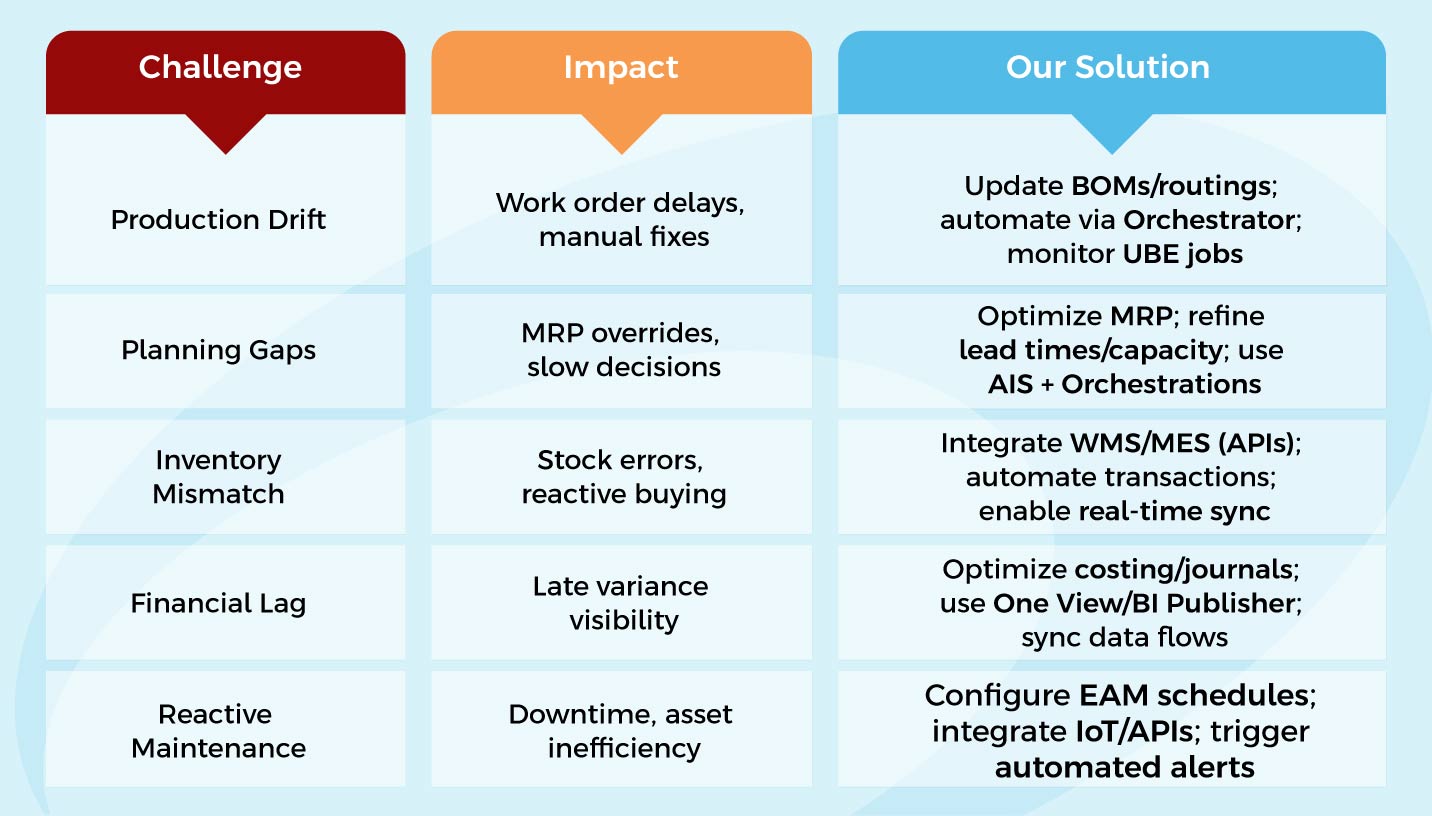
Now, let’s look at day-to-day manufacturing challenges JDE support services must solve.
Production Execution Challenges in JD Edwards Manufacturing
Production processes are well-defined in JD Edwards manufacturing environments.
Work orders are structured. Routings are configured. Bills of materials are maintained. Yet, execution often lacks consistency.
As operations evolve, system assumptions lag behind actual conditions.
Cycle times shift. Component usage changes. Dependencies across processes become more dynamic.
These changes are gradual. But their impact shows up in execution.
Production teams make adjustments on the floor. Shop-floor supervisors rely more on experience to maintain flow.
Ultimately, execution becomes situation driven than system driven.
Planning and Scheduling Gaps in JD Edwards EnterpriseOne
In JD Edwards manufacturing, the planning module offers structure, and data-driven direction.
MRP runs help balance demand & supply. Forecasts compare pasts sales & project future demands for the products. Capacity planning helps align production capacity based on machinery and resources availability.
Still, planning effectiveness depends on how closely system projections align with current operations.
As business conditions shift, system projections start to deflect from real-time operations.
Lead times fluctuate. Capacity constraints evolve. Demand patterns become less predictable.
In response, planning teams introduce adjustments. They start validating system outputs and add buffers to manage uncertainty.
Planning continues to function. But it requires more intervention to arrive at decisions.
Inventory and Supply Chain Issues in JD Edwards for Manufacturing
Inventory and supply chain processes within JD Edwards for manufacturing are built to maintain visibility and control.
Inventory transactions like allocation, transfer, or adjustment are recorded. Intra-depot & warehouse stock movements are tracked. Stock levels monitored by on-hand availability and location-based quantity for visibility.
How consistently data flows across systems determines the operational synchronization.
Maintaining data consistency becomes even more difficult with the increasing transaction volume and process expansion.
Timing differences in inventory tracking start to emerge. Yet, the system might not reflect the movement immediately.
This leads to additional manual validation for coordination across procurement, warehousing, and planning.
This isn’t a JD Edwards E1 system error or lack of capability, but the increased complexity of the operations.
Financial Visibility and Costing Challenges in JD Edwards ERP
JD Edwards ERP offers complete visibility into costs and performance for financial processes.
Production costs are recorded. Variances are calculated. Reports are generated.
Production costs, including component cost, costing structure, and cost methods, are recorded. Engineering, planned, and actual variances are calculated. Analyzing costs and variances; reports are generated.
However, the value of financial data depends on how closely it aligns with operational timing.
In dynamic manufacturing environments, finance continues to offer apt reporting. But, gaps may emerge between real-time events and actual reporting.
Asset Maintenance Limitations in JD Edwards Manufacturing Systems
JD Edwards manufacturing systems provide structured capabilities for managing assets and maintenance.
Asset locations and usability are tracked. Maintenance schedules are planned considering preventive maintenance and condition-based parameters.
The effectiveness of asset management depends on proactive maintenance planning and execution.
A lot of manufacturing environments still rely on event-driven maintenance. Asset issues are addressed as they arise. Maintenance schedules exist but are not optimized.
As operations evolve, spotting patterns in asset performance demands stronger visibility and synchronization within data and decision-making.
This allows you to move from reactive maintenance to proactive maintenance.
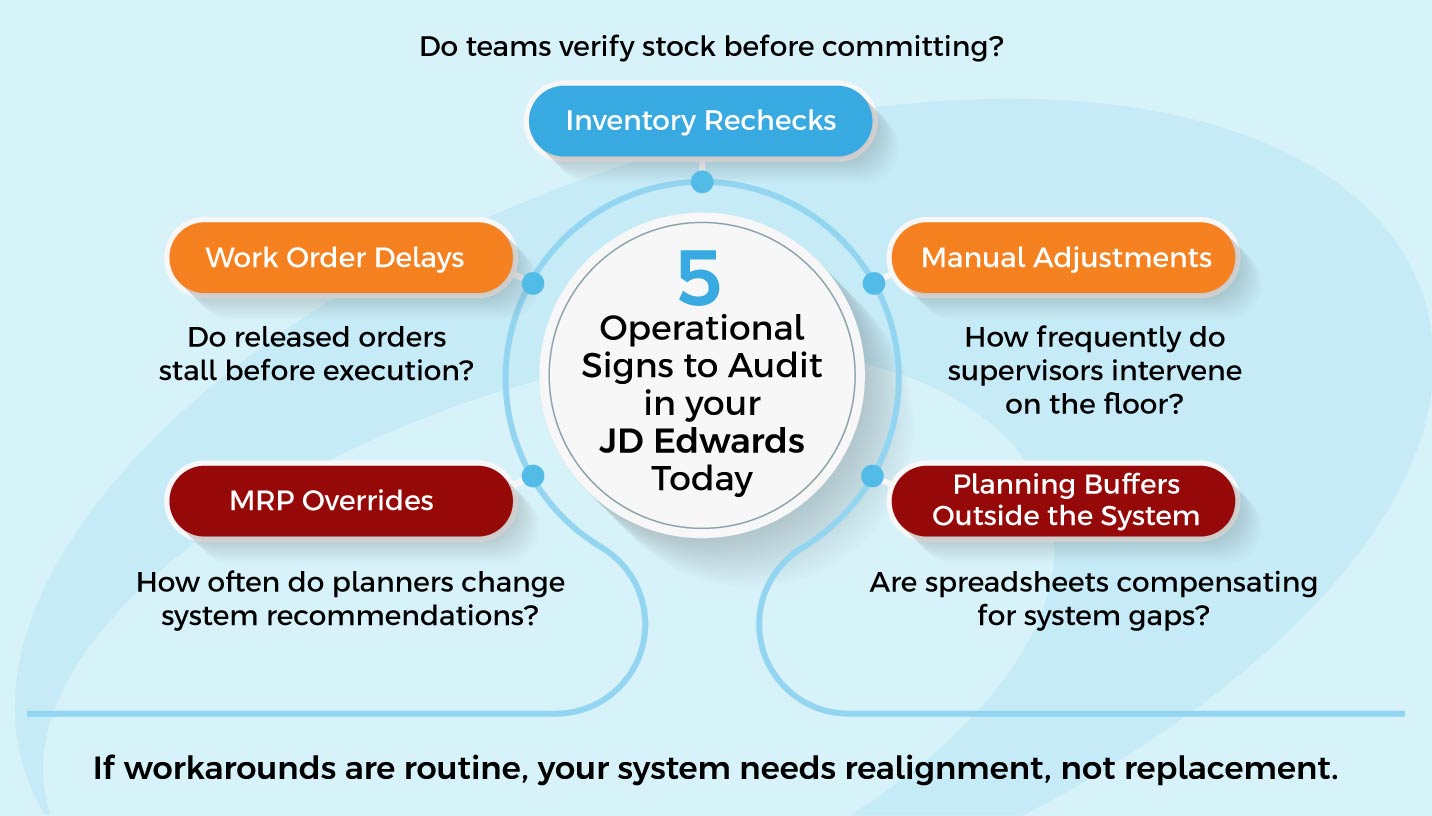
Is it Time to Rethink Your JDE Support?
If your manufacturing team is spending more time working around JD Edwards than working with it, your support model may no longer align with your operational needs.
Here are some common signs that it’s time to move beyond reactive ERP support.
| If your manufacturing team… | It may be time to consider JDE support services that… |
| Relies on spreadsheets to validate ERP data | Improve system accuracy and operational alignment |
| Frequently adjusts production plans manually | Optimize planning and scheduling processes |
| Experiences recurring performance issues | Proactively monitor and optimize system performance |
| Struggles to integrate JD Edwards with other systems | Enable seamless integrations and automation |
| Depends on manual workflows for routine tasks | Automate repetitive processes and improve efficiency |
| Finds it difficult to scale operations | Continuously align JD Edwards with evolving business needs |
These signs don’t necessarily indicate that JD Edwards is failing.
They often indicate that your support approach hasn’t evolved at the same pace as your manufacturing operations.
Next, let’s understand where exactly the traditional JDE support falls short.
Why Traditional JD Edwards Support Services Fall Short for Manufacturing
Most JD Edwards support services are built around one objective – ‘Keep the system running.’
Support tickets come in and resolved. Batch jobs are monitored. JDE performance is maintained.
This works to keep your JD Edwards E1 stable.
But JD Edwards for manufacturing doesn’t need stability alone. It needs alignment.
The problem with traditional JDE support is that it operates in isolation.
A routing update is treated as a configuration change. An integration gap is treated as a development task. A batch job delay is treated as a technical issue.
In reality, it impacts production schedules, planning cycles, and financial outcomes.
Without context, JD Edwards support remains reactive.
It fixes what is required. But it doesn’t address why your operations feel disconnected in the first place.
A structured JD Edwards CNC assessment helps connect these gaps back to how your system actually operates across processes, integrations, and workflows.
It gives you a clear starting point to move from reactive fixes to aligned, context-driven support.
Further, let’s understand what effective JDE support services look like in practice.
“A well-supported JD Edwards environment should evolve alongside your manufacturing operations. When your ERP reflects current business realities, better planning, faster decisions, and greater operational efficiency naturally follow.”
~ Colin Galdo | Engagement Manager – JD Edwards, Integrative Systems
What Effective JD Edwards Support Services Should Deliver for Manufacturing
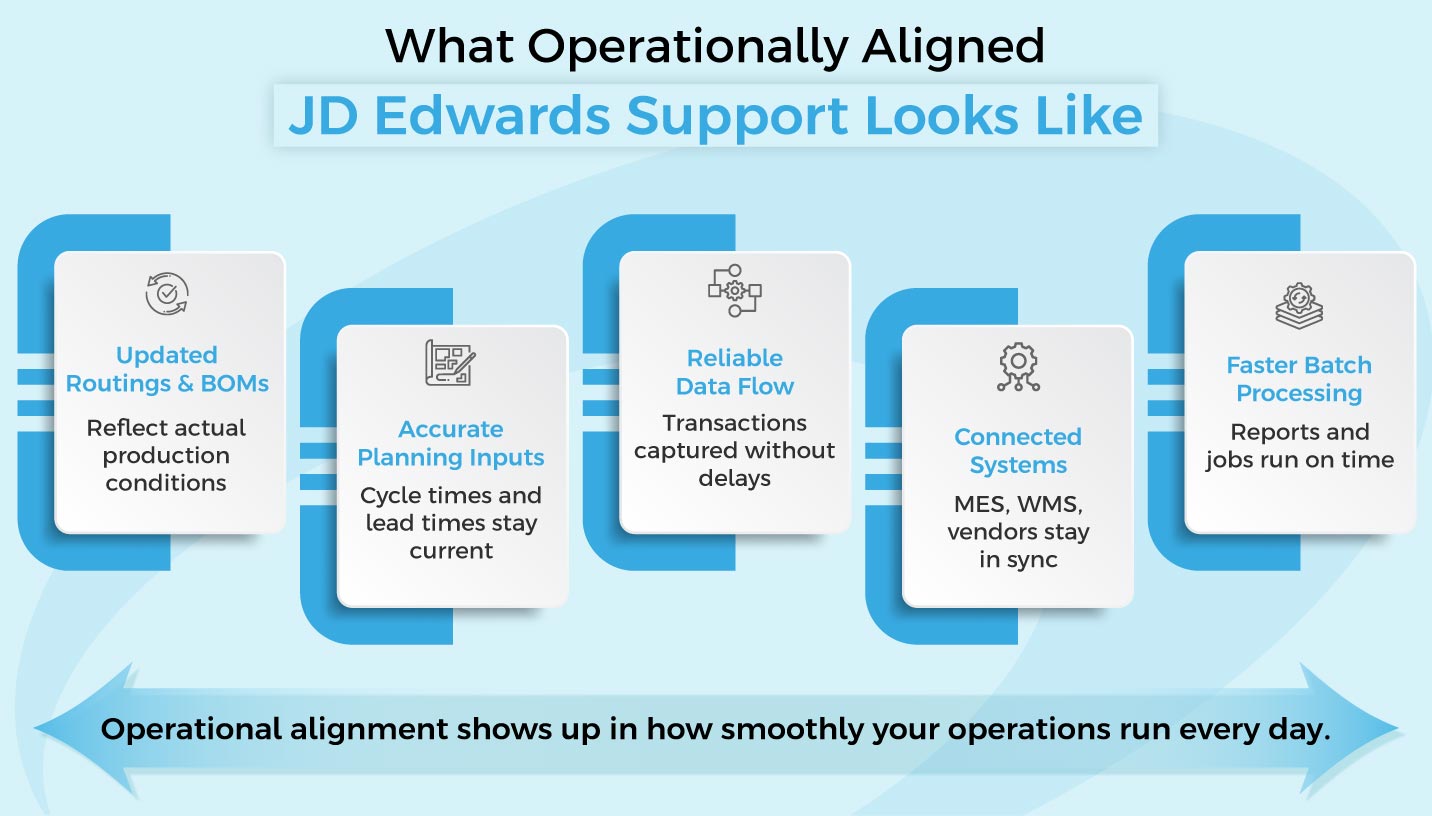
Effective JD Edwards support services should go beyond the classic architecture support and troubleshooting. A holistic, proactive approach to support helps optimize manufacturing ops across production to distribution.
JD Edwards Support must act as an extended function of the business.
Here’s how it looks like in practice.
JDE E1 CNC Support Services for Manufacturing
Administrative CNC support in JD Edwards EnterpriseOne is often treated as backend or infrastructural support. It’s more than that.
In manufacturing, CNC performance dictates how fast business responds.
Every delayed UBE job pushes planning timelines ahead. Every inefficient batch process slows how quickly decisions are made. Every performance lag affects what’s happening on the floor, and what the system reflects.
These are operational delays disguised as system behavior.
Optimizing these workflows restores operational timing and improves system health.
- Planning shortens when batch jobs run efficiently
- Data gets available sooner when processing improves
- Decisions happen real time when system performance stabilizes
This is where structured JD Edwards support services, particularly JDE E1 CNC support services, make a measurable difference.
Our JDE CNC support experts continuously tune how the system processes, prioritizes, and delivers information. Our team considers the operational context and takes a proactive route to performance tuning.
Instead of treating batch jobs and performance tuning as isolated technical tasks, the focus is on how they influence planning cycles, reporting timelines, and shop floor responsiveness.
The team is focused on –
- Enabling faster system processing
- Improving the availability of critical data
- Helping you make decisions that align with real-world conditions
Because in manufacturing, timing isn’t a system metric. It’s a business capability.
Application support in JD Edwards manufacturing environments is often seen as configuration management.
Most systems are configured correctly. But we often neglect the fact that manufacturing isn’t a static niche.
In manufacturing today, the product, processes, and operations are evolving like never before.
And unless the system evolves with them, small gaps persist.
- A routing assuming ideal cycle times
- A BOM that no longer reflects actual components
- A costing model that doesn’t account for real production behavior
Individually, these seem minor. Together, they create friction across planning, production, and finance.
This is where structured JDE application managed services play a critical role in bringing continuous alignment.
At Integrative Systems, JDE application support is led by business analysts who work at the intersection of system logic and operational reality.
They don’t just update configurations. They check –
- Are routings aligned with current constraints?
- Does BOM reflect how production actually runs?
- Is costing capturing what’s truly happening on the floor?
They are focused on –
- Enabling system accuracy
- Improving alignment between planning and execution
- Transforming production environments that behave predictably, not reactively
Because in manufacturing, consistency is driven by how closely your JDEdwards
JD Edwards Development Support for Customization and Integration
JD Edwards development is often approached as customization. In manufacturing, it’s about removing friction between systems, teams, and decisions.
Your manufacturing operations don’t run on JD Edwards alone.
There are shop floor systems, MES platforms, warehouse tools, supplier portals, and logistics systems; all generating and consuming data.
When these systems struggle to communicate, gaps appear.
- Manual updates increase
- Data becomes fragmented
- Decisions rely on partial visibility
Over time, your teams start building workarounds by maintaining a spreadsheet for records, building trackers outside the system, and performing manual reconciliations.
Your JD Edwards is capable of doing it all systematically. It just needs to evolve at the rate your operations have evolved.
This is where JD Edwards development, supported by experienced JDE developers, becomes essential.
Not as isolated enhancements. But as an extension of your operational landscape.
Our JDE development support experts focus on workflow optimization, opportunities for automation, and JDE integration to align your JDE environment with your manufacturing functions.
This includes –
- Integrating JD Edwards with shop floor and external systems
- Automating repetitive workflows across planning and execution
- Building real-time reporting layers for operational visibility
And, this leads to –
- Connected systems
- Improved data flow across functions
- Informed decisions that are faster, clearer, and grounded in reality
Because integrations determine whether your JD Edwards EnterpriseOne keeps up with your operations or slows them down.
Back Office Support for JD Edwards Manufacturing
Data consistency in JD Edwards often shows up first in finance.
It’s measured based on how reliably financial data reflects day-to-day activities.
Accounts payable cycles extend slightly. Receivables take longer to reconcile.
Entries are accurate but delayed when reporting needs them.
Individually, these feel manageable. But over time, they affect how finance teams interact with the system.
Work orders, material usage, and variances reports need additional validation. Inventory and stock reconciliation moves outside JD Edwards E1. GL journal entries, and account closing cycles take longer than expected.
And gradually, the system shifts from being the primary source of financial truth to one that needs confirmation.
This is where structured JD Edwards support services, particularly back-office clerical support, make a difference.
It ensures how your financial processes keep up with your operations.
Through our back-office support services, our back-office specialists work as an extension of your team to maintain consistency and timelines of your financial data across JD Edwards applications.
We help you manage high-volume AP/AR transactions, upkeep accuracy of financial records, and ensure updates align with reporting cycles.
This includes –
- Supporting accounts payable and receivable processes with consistent transaction handling
- Maintaining accuracy across financial records to reduce reconciliation effort
- Ensuring entries are processed in time for reporting and period closures
Over time, this creates a more stable financial layer within JD Edwards.
Reports reflect current activity.
As a result, now your –
- Finance teams start relying on the system with confidence
- Reconciliations need less intervention
- Closing cycles become predictable
Financial processes become stronger when the data is ready at the right time. And that’s what our team focuses on – solutioning you can rely on.
Next, let’s look at real time manufacturing scenarios where JDE support proves instrumental.
How JD Edwards Support Drives Impact for Manufacturing
Impact of JD Edwards support is seen in everyday manufacturing functions; how planning holds up under pressure, how inventory moves across locations, how quickly teams respond when conditions shift.
Following scenarios reflect how effective support upholds operational realities in practice.
When Inventory and Supply Chain Fall Out of Sync
Supply chain struggles begin with how data moves through your JD Edwards.
Procurement reacts to inventory shortages. Warehouse teams deal with stock mismatches. Planning starts to build buffers for production.
Your JD Edwards holds it state. This happens due to misalignment in transaction timing and data flow.
Why does this happen?
Because multiple systems like WMS, MES, and third-party logistics are involved. Inventory accuracy depends on transaction consistency across modules.
Asynchronized updates, loosely configured integrations, and delayed UBEs lead to gaps between actual physical movements and system visibility.
How do we handle this?
Through structured JDE services, including JDE database support services and JDE integration frameworks, we shift the focus to transactional integrity and real-time synchronization.
This includes –
- Optimizing UBE job scheduling and queue prioritization for inventory updates
- Strengthening database-level consistency
- Enabling real-time data exchange using JD Edwards Orchestrator, AIS server, and REST APIs
- Streamlining integrations via business services for external systems
What it enables?
- Inventory reflects actual movement across locations and systems
- Procurement aligns with real demand
- Planning reduces dependency on buffers
- Supply chain decisions happen with confidence, not validation
When Costs Are Visible but Not Actionable
Financial data exists. But it often trails operations.
Variances are visible in reports but connecting them back to production events takes time.
Why does this happen?
Costing in JD Edwards depends on how quickly production, inventory, and financial transactions converge often across separate processes and tables.
Batch-driven updates and delayed postings create a gap between execution and insight.
How do we handle this?
With targeted JD Edwards development, supported by seasoned JD Edwards developers, we extend your system to bring financial visibility closer to production.
This includes –
- Automating variance capture through Orchestrator workflows
- Integrating production and financial data using AIS + REST APIs
- Building real-time reporting layers over key tables
- Enhancing data flow between shop floor systems and JD Edwards through JDE integration services
What it enables?
- Cost visibility moves from retrospective to near real time
- Finance gains context while decisions are still in motion, not after they’re complete
When Downtime Disrupts Operations
Downtime rarely comes without signals. They’re already present, just not connected.
Maintenance schedules exist. Asset data is captured. System logs are available.
But they operate in isolation.
Why this happens?
This happens due to the gap between asset and maintenance data that your JD Edwards reflects and the real-time operational insights from IoT systems.
Batch processing delays and lack of event-driven integration limit visibility.
How do we handle this?
We tackle this through JDE E1 support services and JDE E1 CNC support services, combined with integration frameworks that bring data together.
This includes –
- Optimizing CNC-managed batch jobs (UBE scheduling, kernel tuning, job queues)
- Enabling event-driven updates using Orchestrator + IoT integrations
- Connecting machine data via REST APIs and external monitoring systems
- Building dashboards for asset performance using real-time data feeds
What it enables?
- Patterns become visible
- Maintenance becomes proactive
- Downtime becomes manageable, not assumed
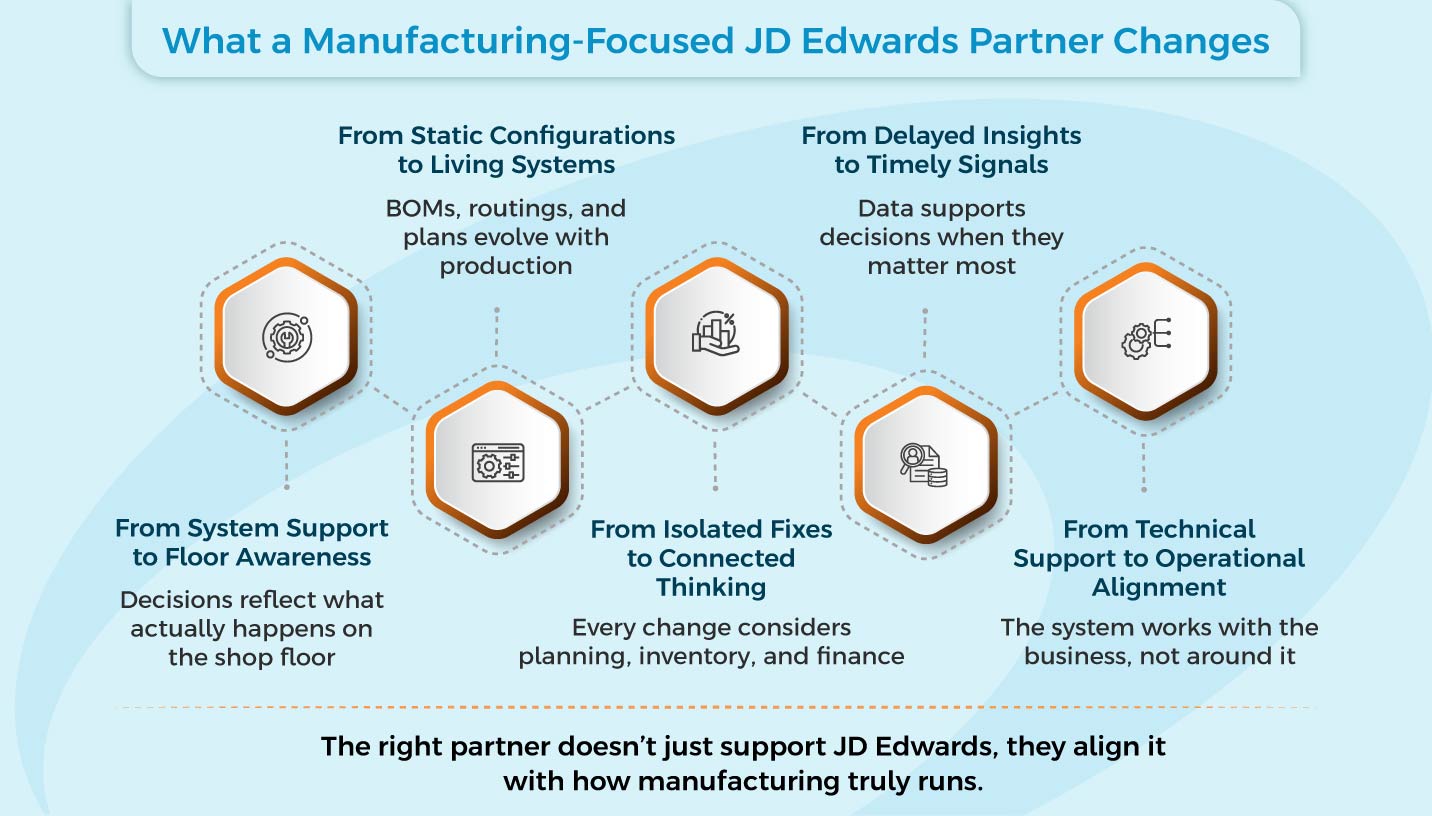
When Complexity Outgrows the System
As manufacturing evolves, system demands increase. JD Edwards remains stable, but business models change.
Engineer-to-order. Lean manufacturing. Project-based execution.
Each introduces new dependencies.
Why this happens?
Business processes evolve over time. And this leads to a gap between core functionalities and operational needs. Yet, the core of your JD Edwards E1 remains the same.
Customizations increase. Integrations multiply. Complexity builds.
How do we handle this?
Through our JD Edwards services, our team of JD Edwards developers help you build a scalable integration architecture that scales with your manufacturing needs.
This includes –
- Extending JD Edwards EnterpriseOne using Orchestrator automation and notifications
- Building integrations via REST APIs, AIS server, and BSSV
- Customizing workflows within E1 applications to match business processes
- Implementing automation for repetitive tasks through JDE automation services
What it enables?
- Your system adapts as business evolves
- Your processes align and workarounds reduce
- Complexity becomes structured, and not chaotic
Customer Success Story
See how we helped a leading manufacturer optimize their JD Edwards integration architecture to improve operational efficiency across multiple business units.
Why Integrative Systems for JDE Support Services?
We understand JD Edwards environments don’t become complex overnight.
They evolve into complexity gradually, and often invisibly.
We know that managing JD Edwards is no longer just about support.
It’s about handling complexity without disrupting day-to-day operations.
And that’s why JDE support services at Integrative Systems are built differently.
Our approach is aligned with your processes, and it evolves with your business needs. We function as an extension of your in-house team and not a vendor who appears only when you need them.
We focus on preventing misalignment.
We dedicate our efforts to operational outcomes.
We believe in thriving as one, by becoming an extension of your team.
Our business analysts align system logic with operations.
Our JD Edwards developers translate requirements into capabilities.
Our CNC specialists ensure performance supports your decision timelines.
We intend to align your goals with our expertise and deliver solutions that you can rely on. The goal is to help you succeed first, always.
To take this further, we are providing a complementary JD Edwards CNC health assessment. If offers insights into how deeply your system is aligned with your operations.
It sets you up for a clear, structured path to strengthen that alignment as your business continues to evolve.
If you’re planning to optimize your JDE EnterpriseOne environment or upgrade to the latest version, drop us a line at contact@integrativesystems.com and team of experts will reach out to you within 2 business days.
FAQs – JD Edwards Support Services
1. What are your JDE support services for manufacturing businesses?
Our JDE support services for manufacturing include system performance, application enhancement, and continued process optimization.
In practice, these services are focused on keeping processes such as planning, inventory, and production in sync. They ensure your ERP reflects the reality of the shop floor.
2. Why do manufacturing companies need JD Edwards support services?
Manufacturing companies primarily need JDE support services to realign the operational scale and expectations with how the JDE system is configured.
3. How does your JDE application managed services help improve manufacturing operations?
Through our JDE application managed services, our JDE experts help you align your system configuration with your current processes. This enables your manufacturing ops to function without friction.
4. How can JD Edwards development and integration benefit manufacturing processes?
As part of our JDE development & integrations services, we provide JD Edwards developers who focus on custom enhancements and performance tuning of your ERP. Also, our JDE integration experts enable your JDE applications to communicate with third-party systems.
5. How can your JDE support services help attain operational efficiency in manufacturing?
Our JD Edwards support experts spot opportunities for process optimization, workflow automation, and unify your manufacturing ecosystem through integration. This helps you attain operational efficiency.
6. What is Included in JDE Support Services?
JDE support services include application support, CNC administration, issue resolution, integrations, performance optimization, upgrades, and ongoing maintenance to keep your JD Edwards environment running efficiently.
7. What is the Difference Between JDE Support Services and JDE Application Managed Services?
JDE support services focus on maintaining and troubleshooting your JD Edwards environment, while JDE application managed services provide proactive monitoring, optimization, enhancements, and strategic support for long-term ERP performance.