

What you choose between .NET vs ASP.NET solely depends on what project you’re building for.
.NET and ASP.NET, both belong to Microsoft’s development ecosystem.
.NET offers wider application development support through desktop, web, mobile, IoT, and cloud. You can choose .NET if you’re building enterprise grade cross-platform applications, backend systems, or mobile-based solutions.
ASP.NET, a web-first framework, offers development support for websites, web applications, and APIs. You can resort to ASP.NET if you’re building customer portals, SaaS platform, eCommerce sites, or API-driven web applications.
In this extensive guide, we are going to uncover the comparison of .NET vs ASP.NET vs Modern .NET at length.
We are going to explore –
- How you choose apt tech stack based on your business goals
- Architectural nuances of .NET vs ASP.NET
- Hiring considerations for .NET developers
- How .NET development services providers can help you attain your goals faster
Let’s get started!
CONTACT US NOW
How do ASP.NET and .NET compare?
While we evaluate .NET vs ASP.NET, the real difference is going to show across scope, purpose of development, and what we are going to build.
For you, this comparison is less of choosing one over the other and more of choosing the right fit for the project you’re building.
If the goal is building a cross-platform application, .NET offers a range. And, if the goal is creating astonishing web-first experiences, nothing beats ASP.NET.
In this section, we’ll compare .NET vs ASP.NET across architecture, different development approaches, programming languages, tools, and real-world cases. The goal is to help you make informed technological decisions.
1. Main Differences among ASP.NET and .NET
| Feature | .NET | ASP.NET |
| Core Use | Multi-purpose framework for web, desktop, mobile apps, cloud services, gaming, and IoT. | Web-centric framework for dynamic websites, web apps, and web services. |
| Platform Support | Cross-platform (Windows, macOS, Linux, Android, iOS) | Primarily web-focused; supports cross-platform in ASP.NET Core. |
| Development Scope | All-encompassing solution (web, desktop, mobile). | Specifically optimized for web applications with tools like MVC and Web API. |
2. Architectural Differences among ASP NET vs NET
.NET offers a complete ecosystem to design, execute, deploy, and maintain a diverse range of applications.
Dot NET framework includes –
- Core Execution Components – Common Language Runtime (CLR), memory management, Just-in-Time (JIT) compilation, & exception handling.
- Extensive Class Libraries – Framework Class Library, and Base Class Library
- Application Models – ASP.NET, ADO.NET, Windows Forms, WCF & WF
In simple words, It’s the development and runtime architecture that is used by your team of .NET developers to modify the process of application development.
ASP.NET architecture includes –
- Programming Models – Includes Model-View-Container, Web Forms, Web API, Razor Pages, SignalR for building different types of applications
- Core Architectural Components – Uses the Common Language Runtime for execution, Razor Syntax for dynamic pages, Kestrel as the Web Server, Base Class Library for common functions
- Built-in Services & Infrastructure – Security Systems, State Management, Dependency Injection, Caching & Performance
- Development Tools – Visual Studio, Visual Studio Code, Editor Extensions
The ASP.NET web applications are primarily component-based and modularized.
3. .NET vs ASP.NET – Comparing Application Development Approaches
Previously, .NET was solely used to develop applications for Windows and PC users, but not anymore.
Microsoft has come up with a new programming interface for APIs and Windows services which is useful for your team of .NET programmers to effortlessly develop a variety of Windows-based applications, along with mobile and web-based applications.
On the contrary, ASP.NET is a part .NET framework dedicated to creating web-centric solutions.
Your team of ASP.NET programmers can use it to develop a wide range of websites hosted on any web server that has both Internet Information Services (IIS) and the .NET Framework installed.
4. NET vs ASP NET – Comparing the Programming Languages
With .NET, your .NET programmers can choose to work with multiple programming languages like C#, F#, VB.NET, IronRuby through CIL (Common Intermediate Language) complier. It allows your developers to work with diverse languages.
With ASP.NET developers can use any language supported by the CLR, mainly C#, F#, & VB.NET.
5. .NET vs ASP.NET – Tools and Library Variations
Officially, Microsoft .NET supports only 3 languages – C#, F#, and Visual Basic.
Yet on the platform .NET supports over 60+ programming languages, including COBOL, Eiffel, Python, C++, Cobra, APL, etc, ensuring language-independent development.
Additionally, it uses a set of development tools such as Visual Studio to unlock a seamless development experience.
There are some things that ASP.NET adds to the platform, such as –
- Base framework for processing web requests in C# or F#
- Libraries like Model View Controller (MVC) for common web patterns,
- An authentication system including libraries, a database, and template pages for multi-factor authentication and external authentication support, Editor extensions for code completion, syntax highlighting, and other efficient web development tasks.
Let’s understand the differences between .NET & ASP.NET in greater depth.
CONTACT US NOW
What is .NET?
.NET (Dot NET) is Microsoft’s open-source development platform for building web apps, desktop software, mobile apps, APIs, and cloud-based solutions.
It gives development teams one ecosystem for creating different types of software without relying on separate frameworks for each need.
That matters in real business environments. Many companies run customer portals, internal tools, reporting systems, and backend integrations at the same time. Managing each on a different stack adds cost and complexity. .NET helps simplify that.
What are the Key Aspects of .NET
- It’s cross-platform by design – Supports Windows, Linux, and macOS
- Strong ecosystem support – Supported by Microsoft and a global developer community
- Delivers strong performance – Commonly used for applications where speed and reliability matter
- Provides built-in runtime services – Offers Common Language Runtime (CLR) for execution, memory handling, and security
- Extensive component libraries – developers can pick and use ready-made components than building from scratch
- Holistic development – Supports multifaceted development; web, mobile, desktop, and cloud
What is .NET used for?
.NET supports fresh development and modernization of legacy applications, alike. It is often used in environments where an application must last, integrate with other applications, and scale over time.
Common Use Cases of .NET
- Web apps – Customer portals, dashboards, and APIs using ASP.NET Core
- Mobile apps – iOS and Android applications through .NET MAUI
- Desktop software – Windows tools and business applications still central to operations
- Enterprise software – Workflow systems, reporting tools, ERP extensions, internal platforms
- IoT solutions – Software powering connected devices and smart equipment
- Cloud systems – Microservices, SaaS platforms, and serverless workloads
- Gaming – Applications and games built with tools such as Unity
Why Many Teams Still Choose .NET
- Easier to standardize on one technology ecosystem
- Reliable for long-term enterprise projects
- Large pool of experienced .NET Developers
- Strong fit for modernization roadmaps
- Ongoing Microsoft investment and support
.NET is more of a practical choice for technology leaders than a trend they would follow. Because it allows their teams to work in a scalable environment where they can build diverse applications, with future options always open.
What is ASP.NET?
ASP.NET (previously known as Accelerated Server Pages) is Microsoft’s free, open-source web framework used to build high-performing, secure, and scalable web applications.
.NET developers choose it when they want their web systems to process transactions, connect with other systems, manage users, and handle growth reliably.
Why is ASP.NET used for Web Development?
- Supported by Microsoft and the wider .NET ecosystem
- Delivers well under growing traffic and usage demands
- Supports secure login, authentication, and access control
- Built for creating dynamic websites and web applications
- Connects smoothly with databases, APIs, and cloud services
- Compatible for both new development and modernization projects
What is ASP.NET used for?
- Self-service customer portals
- Internal workflow applications
- Partner portals and secure extranets
- e-commerce and transactional websites
- REST APIs for mobile or third-party apps
- Reporting dashboards and admin panels
- SaaS products and subscription platforms
Why Teams Prefer ASP.NET?
For teams working in the Microsoft ecosystem, ASP.NET is the first choice for web development. Teams working on other ecosystems are lured by the security, scalability, and community support for ASP.NET, which are the major drivers.
For many organizations, it offers a dependable route to building serious web platforms without changing technology direction later.
Is ASP.NET part of Dot NET?
Yes. ASP.NET is a free and open-source web development framework from MC, while Dot NET is a free and cross-platform development platform.
Here’s how the two compare & coexist.
.NET offers a wide range of development avenues. With .NET you can build –
- Web applications
- Mobile applications
- Gaming applications
- Desktop applications
- Cloud services and Microservices
Whereas the scope of ASP.NET is a smaller subset of .NET’s scope. Using ASP.NET you can build –
- Microservices
- User Interfaces
- Secure web APIs
- Scalable web applications
- High performing websites
How the Two Work Together?
In simple terms – .NET offers the foundation to build software applications. And ASP.NET offers the building blocks to build upon the foundation.
.NET offers a secure development environment for software development where it extends – runtime services, shared component libraries, and core development support.
ASP.NET carries the load for web development including user facing functionalities, page handling, authentication, routing, etc.
Where ASP.NET Is Typically Used?
You are likely to find ASP.NET in projects like –
- Subscription-driven SaaS platforms
- Internal employee systems
- Customer account portals
- Reporting dashboards
- eCommerce websites
- REST APIs
In Simple Terms – ASP.NET vs ASP.NET Core
- NET – The original web development framework within the Microsoft Dot NET ecosystem used, to build dynamic web applications & services strictly for the Windows platform
- NET Core – A refined web development framework that supports Linux/macOS based applications and cloud hosting
- NET MVC – Type of code architecture used for organizing code into three parts Model-View-Container. It’s used for organizing code in ASP.NET development environments
What Matters for Businesses?
If your older ASP.NET application still meets your operational needs, you don’t need to migrate it to the ASP.NET Core platform.
If you are planning to create an application, choose ASP.NET Core because ASP.NET Core provides flexibility, it provides improved performance & it provides better scalability, for your new application.
Now, we’ll explore comparing .NET and .NET Core with Modern .NET.
.NET Framework vs .NET Core vs Modern .NET
.NET Framework, .NET Core, and Modern .NET are three different phases of Microsoft .NET’s evolution journey.
.NET Framework is the oldest, launched as a Windows-first version. Later, came .NET Core, launched as a cross-platform framework. And Modern.NET is most recent unified platform that supports all the previous versions.
The confusion often happens while you review the legacy applications, plan for upgrades, and hire .NET developers. Similarity in the naming conventions often leads to wrong decisions.
.NET, .NET Core, and Modern .NET serve three different stages of technology maturity. And you must consider reviewing it before making any decision related to your tech stack or hiring.
What Each One is Meant for?
- .NET Framework – Well known for former Windows applications, long-standing legacy systems, and internal tools
- .NET Core – Refined generation that initiated support for Linux, macOS, and lighter deployment models
- Modern .NET – Latest generation that supports application development through .NET 5, 6, 7, 8, and onward
Where does Each One Usually fit?
- .NET Framework – Supports long-standing applications built in Windows environments
- .NET Core – Supports applications built in the transitioning phase where application development started to shift away from frameworks
- Modern .NET – Supports modern-day web applications, Microservices, APIs, cloud-based services, mobile solutions, and innovation
What Modern .NET Brings?
- Runs across Windows, Linux, and macOS
- Better suited to cloud hosting and containers
- Strong performance for modern workloads
- One ecosystem for web, backend, desktop, and mobile development
- Active Microsoft roadmap with continued releases
Practical Decision View
If a legacy application is doing its job, maintain it sensibly. If you are building something new or planning for growth, Modern .NET is where most teams now focus their investment.
For many businesses, the real question is no longer Framework versus Core. It is how to move forward without disrupting systems that still matter today.
CONTACT US NOW
How do You Decide between ASP.NET vs. .NET?
What kind of application you are building impacts your choice between ASP.NET vs .NET.
.NET is a complete software development suite that lets you build, run, and execute applications across platforms.
ASP.NET is an exclusive web application development framework that lets you build websites, web apps, and APIs.
Here’s a better interpretation of when to choose what.
| .NET | ASP.NET | Why It Matters for Your Business |
| A complete software development framework for Windows, Web, and Server-based applications. | A core tool within .NET focused on building dynamic, data-driven web applications. | If you need enterprise-wide solutions, .NET provides flexibility. If you want modern web apps, ASP.NET accelerates delivery. |
| Supports both server-side and client-side application development. | Designed specifically for server-side web development. | For multi-platform applications, go with .NET and for web-first strategies, ASP.NET is the smarter choice. |
| Ideal for building large-scale business apps on Windows platforms. | Tailored for creating high-performing websites and interactive web portals. | Choose based on whether your priority is enterprise applications or customer-facing web solutions. |
| Works with multiple programming languages via the CIL (Common Intermediate Language) compiler. | Compatible with any NET-supported language for web development. | The flexibility to leverage existing developer skills while ensuring scalability for future needs. |
.NET vs ASP.NET – When Should You Choose .NET?
Choosing the .NET framework makes sense when –
- Expanding functionalities of the existing application
- Developing an enterprise-grade solution that works across platforms
- Working on time-intensive project that demands scalability and flexibility
- Seeking a stable development environment that’s both secure and scalable
ASP.NET vs .NET – When Should You Choose ASP.NET?
ASP.NET is the best choice when –
- Seeking a web-centric framework for building a dynamic web application
- Building web apps that demand interactive features and real-time communication (E.g. live updates)
- Developing applications that run on web server and need performance optimization
- Seeking a dedicated web-development framework offering tailored environment for building dynamic web applications
Still thinking what makes an ideal fit for your next project between ASP.NET vs .NET?
CONTACT US NOW
Why Business Partner with .NET Development Services Provider?
Hiring an in-house team is a great idea. It also has another side.
While hiring a team, it’s critical to evaluate how the NET framework vs ASP.NET applies to your project’s architecture and future scaling potential.
Such as –
- Cost of hiring and managing an in-house team of .NET programmers
- Bad hires impacting the quality of your application development
- Chances of delayed project delivery due to inexperienced .NET developers
- Possibilities to scale your team size up and down as required
You don’t have to second guess your chances of success with a Dot NET development services provider.
An extended team of .NET experts helps decide on the tech stack and takes care of the project management from planning to delivery. They do the heavy lifting, while you focus on the strategic initiatives.
With .NET service providers, you get –
- Ready access to cohesive and multi-disciplined developers
- Ability to scale the team up and down easily and quickly
- 24×7 support to ensure seamless operations
- Access to a wide range of talent pool
- Guaranteed cost-effectiveness
- Only one-time hiring decision
- Better control over cost
Thinking, “How do I trust an external .NET development partner with my project?”
With a trusted ASP.NET services partner you have –
- Direct control over the team that is highly responsive
- 24×7 support to ensure seamless operations
- Single-minded focus with a dedicated team
- Flexible engagement options
- Easy exit guarantee
Next, let’s explore the best time to invest in custom .NET development services.
CONTACT US NOW
When do You Need Custom .NET Development Services?
The custom software development market size is projected to reach $181.81 billion by 2031, according to The Insight Partners.
As technology advances, as a decision-maker, you want to make the most of it. That’s where a technology partner makes the difference.
This is where a .NET development services provider adds value.
1. When You are Struggling to Meet Customer Expectations
Data shows that 73% of customers will switch to a competitor after multiple poor customer experiences, according to Zendesk.
Meeting customer expectations is the least you must do.
What Changes with .NET Software Development Services?
An extended team of .NET developers help prioritize customer experience through faster load times, seamless integrations, personalized experiences through custom .NET development services.
They ensure you .NET application meets your customers’ expectations.
The result? A happy and loyal customer base.
2. When Your in-house .NET Team is Inexperienced
There are about 5,000,000 .NET experts available globally.
Having an in-house team of .NET developers who understand your business is a blessing.
But, if you have a good team that is keen and driven to do the job, but lacks the experience; it demands reconsideration.
What Changes with .NET Software Development Services?
Through .NET application development services, a pre-vetted team of .NET experts help you fill the skill gap, match the deadlines, and get your project on track.
They go beyond filling the skill gaps and keep you ahead of the race while your internal team focuses on core business pursuits.
The result? Quicker turnarounds and timed deliverables.
3. When Your Current .NET Company isn’t Helping Your Enough
Most .NET companies overpromise and underdeliver.
3/10 leaders who approached us for .NET consulting services dealt with high costs and poor results from their previous .NET software development outsourcing partner.
3/10 technology leaders we spoke to were unhappy with the services of .NET consulting services providers. The costs were high, but the output was poor.
That naturally drew them to the thought of having an in-house team than working with a .NET development services provider.
What Changes with Dependable NET Software Development Services?
Through structured .NET application development services, an extended team of .NET programmers ensure you don’t miss deadlines, and the results match our expectations.
A technology partnership isn’t another vendor relationship. Your technology partner must focus on delivering solutions you can rely on.
Here’s what you must look for in an ideal .NET development company before you sign the contract –
- They prioritize your success
- They are honest about their failures
- They say no to what they cannot do
- They have transparent pricing and uncomplicated exit clauses
- They take steps instead of an elevator to ensure long-term success
Here’s how you can find a dependable .NET development company in the USA.
CONTACT US NOW
What to Look for in a Reliable .NET Development Company?
Your choice of custom ASP.NET development services partner can make or break your .NET project.
Here are some factors you should consider –
- Team strength
- Specialization in .NET
- Transparency in pricing
- Clarity on additional costs
- Post-development support
- The vision of long-term partnership
- Years of presence in the IT industry
- The idea of a collaborative approach
- Portfolio with relevant projects & case studies
- A well-versed team with knowledge of relevant tools
- Well-established implementation practices for security & compliance
These are the top factors you must consider when planning to outsource .NET development to a technology partner.
Given the abundance of choices, are you wondering where to find ‘The One’?
CONTACT US NOW
Why Integrative Systems is the .NET Development Company You Need?
As your trusted .NET development company can become your partner in creating .Net applications of any complexity. We bring 20+ years of expertise in this domain. We choose to help you succeed first. Our approach is our differentiator.
As your technology partner, we extend your in-house team, map your goals against our expertise, and deliver .NET solutions that you can rely on.
- Focused on building lasting customer relationships – 97% customers choose to continue working with us
- Committed to delivering measurable outcomes – Double the ROI at half the cost
- Driven to helping you succeed first – Building solutions at scale
- Delivering solutions you can rely on – Aligned to your business goals
Partnership/Certifications

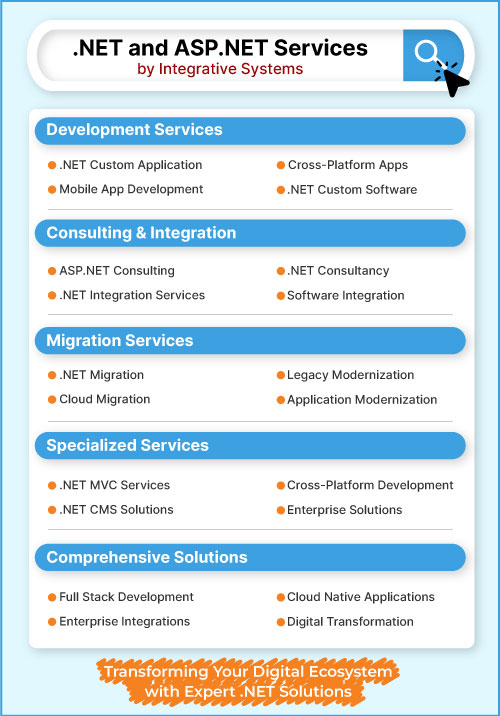
Here are .NET and ASP.NET services we offer.
- .NET Consulting Services
- Mobile App Development
- On-prem to Cloud Migration Services
- Custom .NET Application Development
- .NET Integration and Migration Services
- Legacy Application Modernization Services
You get to access a pool of trained experts, including –
- .NET QA tester
- Lead .NET Architect
- .NET Project Manager
- Junior .NET Developer
- Senior .NET Developer
- Full Stack .NET Developer
- Mid-Senior .NET Developer
Integrative Systems is not just another .NET development company, but your innovation partner.
Whether it’s custom software development, web app modernization, or cloud integration, we ensure you get what you need.
If you feel we are the perfect fit to drive your .NET development project from idea to reality, drop us a line at contact@integrativesystems.com , and our team of experts will get back to you within 2 business days.
Let’s bring your vision to life.
NET vs ASP NET FAQs for Business Leaders
What differentiates ASP.NET and .NET?
ASP.NET is suitable for building websites, web applications, and APIs. .NET is made up for full-circle software development ranging from desktop, web, mobile to cloud applications.
Why ASP.NET is still relevant in 2026?
ASP.NET supports web, cloud, and API development through .NET 8 & ASP.NET Core. It extends high performance, security, scalability and integrates well with Microsoft. That’s good enough for a web framework to sustain and dominate in 2026.
Can Dot NET be used for web development?
Yes, .NET framework supports full-circle application development from desktop, mobile, web to cloud. Use ASP.NET or ASP.NET Core according to your web development requirement.
What’s the Difference Between ASP.NET Developers & Dot NET Developers?
.NET developers are experts in building web, desktop, and mobile applications. They work on various types of projects.
On the other hand, ASP.NET developers focus on web applications, websites & web APIs. And ASP.NET experts in building web applications.
What is the difference between ASP.NET Core and ASP.NET ?
Both web application frameworks from Microsoft. ASP.NET supports windows-only web development. While ASP.NET Core is the emerging version that supports cross-platform, cloud–native web application development.
Why Is ASP.NET so Popular?
ASP.NET makes the perfect fit for web application development, no matter enterprise grade or medium scale. It offers stability for environments that demand security and performance. And, also offers cross-platform compatibility for rapid development needs.
When to choose ASP.NET instead of .NET?
Choosing between ASP.NET & .NET focuses on specialization. Dot NET to build any type of application, desktop, mobile, cloud, or IoT, and use ASP.NET within .NET to create web applications & services.
Why is ASP.NET Still used in 2026?
NET has emerged not only as a Windows-only framework but even as a cross-platform, cloud native framework in 2026. That’s why it’s the primary choice for high-performing enterprise-grade applications where security & scale matter most.
Is ASP.NET Limited to C#?
No, you can write ASP.NET in C# F#, or Visual Basic. This includes business logic & data access. The reason is that ASP.NET is built on the .NET Framework. This gives Dot NET developers access to a range of packages and libraries.








15 Comments to “.NET Vs ASP.NET – Make the Right Choice for Your Next Project”
Ssstiktok
Great post! I found the comparison between .NET and ASP.NET really helpful. It clarified a lot of confusion I had about when to use each one. I appreciate the detailed explanations and examples!
Nathan
This blog post really clarified the differences between .NET and ASP.NET for me! I appreciate the detailed comparison and examples. It’s helpful to know which one might be better suited for my project needs. Thanks for the insights!
Williams
Thanks for the insightful comparison! This will definitely help in making the right choice for the next project.
Garcia
Thank you for sharing this insightful comparison between .NET and ASP.NET! The breakdown of the differences and use cases is really helpful for making an informed decision on which framework to choose for my next project.
James
Great comparison! I appreciate how you broke down the differences between .NET and ASP.NET. It really clarified my understanding of when to use each framework. Looking forward to diving deeper into my development choices now!
Mike
Great breakdown of the differences between .NET and ASP.NET! It really helped clarify which framework would be better suited for my upcoming projects. I’m leaning towards ASP.NET for my web applications now. Thanks for the insights!
Jerry Moody
Great breakdown of .NET and ASP.NET! I appreciate the clarity you provided on when to use each one. It’s especially helpful for someone like me who is just starting out in web development. Your examples really make it easier to understand the differences and choose the right framework for my projects. Thanks for sharing!
Elijah Wilson
Great post! I found the comparison between .NET and ASP.NET really helpful. It clarified some of my confusion about when to use each technology. I appreciate the examples you provided!
Noah Smith
This was a really insightful comparison! I always found it confusing to differentiate between .NET and ASP.NET. Your explanation helped clarify their roles and when to choose one over the other. Thanks for breaking it down so effectively!
Scarlett Moore
Great insights in this post! I’ve always found the distinction between .NET and ASP.NET a bit confusing, but your breakdown made it much clearer. I appreciate the examples you provided for practical use cases. Looking forward to trying out ASP.NET for my next web project!
Thompson
Great insights! I appreciate the breakdown between .NET and ASP.NET. It’s really helpful to understand the differences and how they can impact project decisions. I’m leaning towards ASP.NET for my next web application, but I’ll definitely consider the points you’ve raised. Thanks for sharing!
Thompson
Great insights! I’ve been trying to decide between .NET and ASP.NET for my upcoming project, and your breakdown of their differences really clarified things for me. I appreciate the examples you provided; they were super helpful in understanding which framework might suit my needs better. Looking forward to implementing some of these tips!
Grace Martin
Great breakdown of .NET and ASP.NET! I appreciate the clarity you brought to the differences between the two. It’s helpful to see the pros and cons laid out, especially for someone like me who is considering options for my next project. Looking forward to more insights!
Isabella
Great insights! I appreciated the breakdown of .NET and ASP.NET. It really helped clarify the differences and which framework to choose for specific projects. Looking forward to more posts like this!
Mike C
Great post! I found the comparison between .NET and ASP.NET really helpful. It’s clear that choosing the right framework depends on the specific needs of my project. I appreciate the detailed insights you provided!